



Of the permanent and the particular
Whenever we talk about “problems” in the Church, we first need to determine whether it is a particular problem of the moment, or whether it is the perennial problem of fallen human nature. Now, as clear as this distinction may appear at first glance, it is anything but obvious where the dividing line is to be found. Let me explain.
There are some problems in the Church that appear at particular times and for particular reasons. For example, the Protestant heresy arose at a specific moment in time due to the theological, moral, and social collapse of the late Middle Ages.
Other problems in the Church, however, are linked to our nature. These are not time-bound and arise repeatedly, or in certain cases, never go away. For example, sexual morality will always be an issue in the Church because of fallen nature. The Albigensians came and went, but our inability to master ourselves will never go away. Both are problems in the Church, but they are different kinds of problems necessitating different kinds of solutions. So far, so good.
The problem is that every “issue” in the Church is in some way linked to nature. Whether it be the feeble will of an errant clergyman, or the feeble mind of an errant ordinary — whether it is confusion about the incarnation or our inability to keep our self-control — they all eventually involve some aspect of our fallenness. While there is still clearly a distinction between the two kinds of problems, there is not always a demarcation between where one ends and the other begins. And this matters a great deal.
Thus, every problem in the Church needs to be categorised as either something to be overcome and put away for good, or something to be overcome over and over again. And the first place for us to start is our current obsession with synodality. Is this just some theological cancer that can be quarantined and cut out? Or is it a problem spread over the whole body that will need constant chemotherapy until the Last Day? Is synodality our problem or the Church’s? Before answering this question, let us first describe why it is a problem, and then decide what kind of problem it is.
The silliness of synodality
To ask whether a thing has purpose is to ask why it matters. A thing without purpose is like a man without hope: they both have somewhere to be, but no real reason for being there. A man without hope is not a sad man, not at least in the conventional sense; but he is a busy one. He rises to greet the rosy fingers of dawn, shaves, and then catches the 7:45 (when it arrives on time). He answers all his phone calls, replies to all his correspondence, and does everything with all the fastidiousness of a man who has silently decided that none of it matters. This is why men without hope make excellent administrators. Hope, to the modern world, is so dreadfully inefficient. Hope insists on asking not just what time the train is due to arrive, but where it is going and whether or not it makes sense to go there. This tends to impact efficiency.
A thing without purpose is his doppelganger — minus the animation. A purposeless thing is like a brass key that knows nothing about locks. It is not exactly idle — which would at least be honest. Rather, if anything can be said about it, it is that it has never been shinier or shapelier — since it opens nothing. A key that opens locks is tarnished, worn thin from the scratches and scrapes of pocket change and rusty bolts. A working key is a tool. A key that opens nothing is a relic, and men will pay good money for a relic. It has failed upward. But no one, out of a warped sense of delicacy, is ever likely to bring this up.
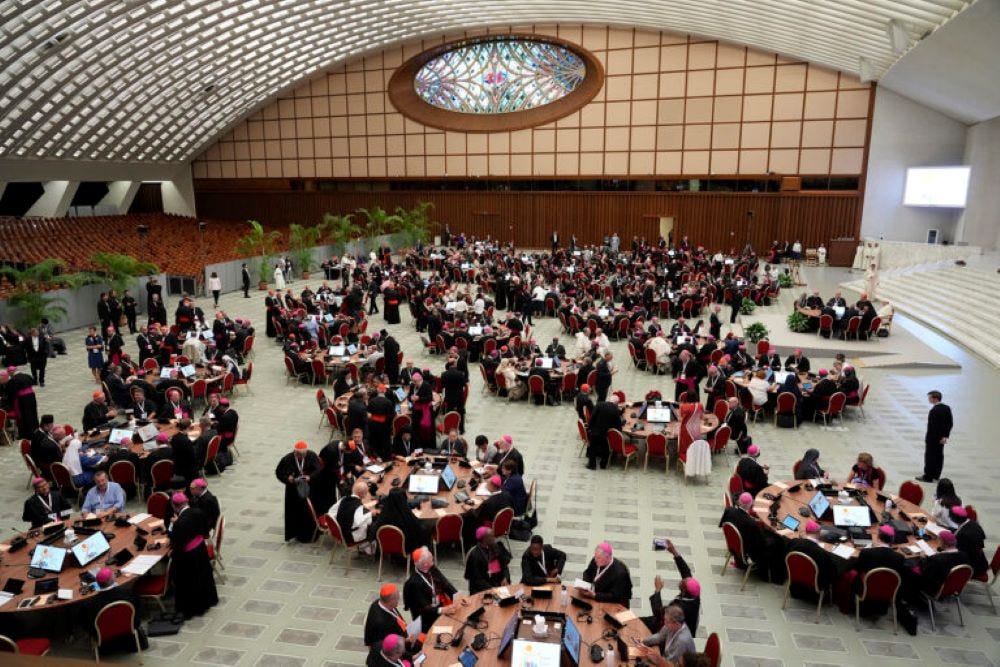
Thus, it is with synodality — a key for which there is no lock. A cure for which there is no disease. Take away a thing’s purpose and all that is left is process. A man without hope perfects his despair the same way the Committee for the Overcomplication of Perfectly Simple Affairs (COPSA) perfects its minutes — thoroughly, punctually, with an ever-expanding sense of pride proportional to how fruitless the task is in the first place. The tragedy is that such a man, a key, or a synod never stops moving. They move perpetually, even gracefully, forever toward nothing in particular, and then call it progress. For to call it what it truly is would mean admitting that the journey is over and that they have arrived precisely nowhere.
This is a very common problem amongst the clever and the credentialed. The common man is rarely troubled by such realities, being far too sensible for things of this sort, for the only “common” thing about him is his sense. Only a clever man can dress up a process until it looks like a purpose, so that nobody notices the subterfuge. I am going to suggest, to your shock, horror, and dismay, that this is happening right now in the Eternal City, within a shadow’s throw of the mighty dome under which I became a priest.